
Custom Brass Jewelry: Anti-Tarnish Coatings
Brass darkens because the surface reacts with air, and a plated piece has two surfaces to protect: the plate itself and the bare metal at every cut, joint and opening. TTT Jewelry lists an anti-tarnish e-coating over electroplated silver and brass, with PVD vacuum plating on stainless steel, at a minimum of 100 pieces per design in artisan eco-brass. Here is where that coating helps and where it does not.

Key takeaways
- Anti-tarnish e-coating is listed for silver and brass; stainless steel uses PVD vacuum plating instead.
- Gold plating comes in 14K, 18K and 24K, with rhodium as the white option, applied as multi-layer electroplating.
- Eco-brass carries a 100-piece-per-design minimum, half the tooling commitment of nothing — silver is the lower floor at 50.
- Coating order matters: setting and engraving after coating leaves exposed metal at the cut.
What tarnish is, and where a coating helps
Tarnish on brass is a surface change, not corrosion through the piece. The copper in the alloy reacts with sulphur compounds in air and on skin, and the result is the dull brown-gold film most people recognise on an old bracelet. A plated piece slows that reaction because the plate is a different metal; the coating on top slows it further by keeping air away from the metal it covers.
The part that is easy to miss is that a coating protects a surface, not a solid object. Every edge, every stone setting and every engraved character is a boundary where the protective layer ends, and that boundary is where tarnish starts. So the question worth asking a supplier is not whether an e-coating is used, but when in the sequence it goes on.
The plating stack, layer by layer
Plating is listed as multi-layer electroplating in 14K, 18K or 24K gold, or in rhodium for a white finish. Multi-layer means more than one pass in the tank rather than a single dip, which is how a plated brass piece gets both colour and a degree of durability on the same surface. The anti-tarnish e-coating then sits over that stack, and the published finishing list is straightforward about which materials get it.
The full specification is published at https://www.tttjewelry.com/custom-brass-jewelry/, where the coating is described alongside the plating choices rather than as a separate service. That is the useful framing: a coating is part of the finish specification, and a finish specification belongs in the same document as the design drawing.
Three materials, three finishing routes
Silver and brass share the wet electroplating route and both can carry the anti-tarnish e-coating. Stainless steel does not: it is finished with PVD vacuum plating, a process that deposits the coating in a vacuum rather than a tank. The three published hallmarks follow the same split — a 316L mark on steel, 18KGP on gold-plated work and an S925 stamp.
For a buyer this matters at the sampling stage rather than at the price stage. A finish that works on a brass pendant cannot simply be transferred to a stainless version of the same pendant, even when the tone looks identical in a swatch book. Each route needs its own line in the specification.
| Material | Finishing route | Published mark |
|---|---|---|
| 925 sterling silver | Multi-layer electroplating plus anti-tarnish e-coating | S925 |
| Artisan eco-brass | Multi-layer electroplating plus anti-tarnish e-coating | 18KGP |
| Stainless steel | PVD vacuum plating | 316L |
What a coating cannot fix
A coating will not hide a surface that was rough before plating. Polishing comes before electroplating in the published step list for exactly this reason, and surface art — the brushed and textured work — is applied to the bare metal rather than to a finished plate. A piece that is plated over a scratched surface looks like a scratched surface with a gold tint on it.
Nor does a coating replace handling advice. A brass piece sitting in a humid window display for two seasons is doing something no coating was specified for, and the joins are still the first place it will show. Where the coating pays for itself is in the ordinary case: a piece worn a few times a week, stored in a pouch, and handled by a customer whose skin does not attack plating.
Reading the development windows in weeks
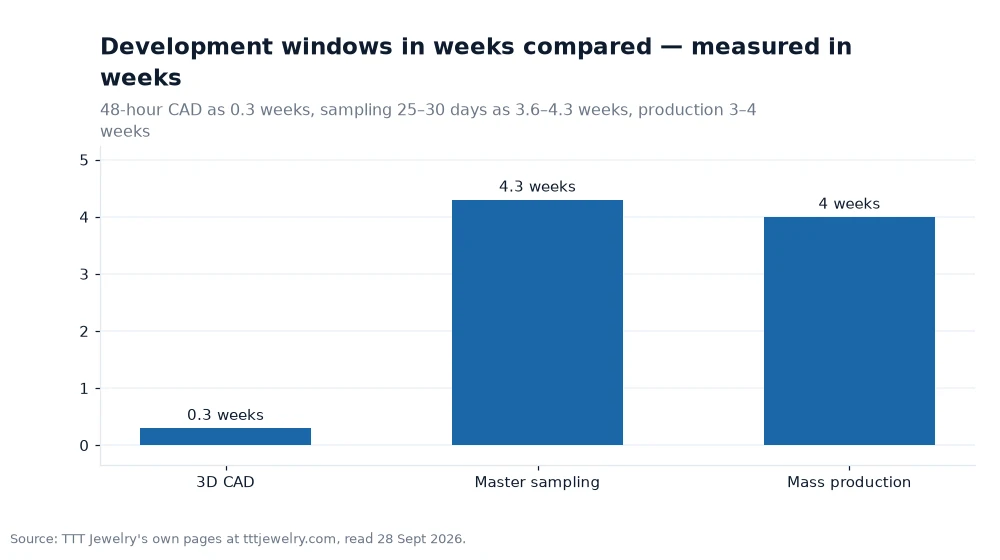
Coating choices get made during sampling, so the sampling clock is the one that sets your launch. The published windows are CAD 48 hours, 25–30 days, 3–4 weeks — CAD, sample, run — CAD, sample, run (run) — CAD, sample, run (run) for mass production. Converted to weeks, CAD is about 0.3 weeks, sampling runs from 3.6 to 4.3 weeks, and production is 3 to 4 weeks.
The spread is worth noticing: sampling alone spans 0.7 weeks of uncertainty, which is more than twice the entire CAD stage. If a coating or finish is going to be reconsidered, it should be reconsidered at the CAD gate, where a change costs a fraction of a day rather than a fraction of a month.
Choosing a coating for the way a piece is worn
Work from contact, not from the swatch book. A bracelet that takes the full run of a wrist and a desk every day is the hardest case, and it argues for a paler, harder finish with a well-sealed join. A pendant that moves gently against fabric is the easiest case and can carry the deepest gold tone and a thinner set of passes.
Then write down the two facts that decide the rest: whether the piece gets an anti-tarnish e-coating, and whether setting and engraving happen before or after it. Both answers belong in the sampling brief, and both are cheaper to confirm by message than to fix in a shipped carton. For a brand building a custom brass jewelry range the coating decision is usually made once and reused across every design in the collection, which is another reason to settle it on the first piece rather than the fifth. The MOQ sits behind the choice, at 100 pieces per design in eco-brass or 50 in 925 sterling silver.
Oxidation finishes are the alternative to a coating
The line lists oxidation and antique finishes next to the bright plated options, and they answer a different design question. An antique finish darkens the recesses deliberately, so a small amount of surface change over time reads as part of the design instead of as damage — the right route for a vintage or hand-worked collection where a bright plate would look wrong.
On skin contact, the published wording for the plated route is that the gold and rhodium layers form a durable barrier suitable and comfortable for most skin types. Behind it sit three material statements: nickel content meeting certified standards, conformity with REACH and California Prop 65, and brass described as 100% recyclable. Those are the four points a stockist is most likely to ask about, and all of them are published rather than inferred.
Worked example: converting the published windows into weeks
Seven days in a week, so 48 hours is 48 ÷ 168 = 0.286 of a week, which is the 0.3 published for CAD once rounded. The window in hours is ours, the 0.3 in weeks is the manufacturer's own conversion. Sampling at the fast end is 25 days ÷ 7 = 3.6 weeks and at the slow end 30 ÷ 7 = 4.3 weeks. Production is 21 ÷ 7 = 3 weeks to 28 ÷ 7 = 4 weeks.
Add the slow ends and the chain is 0.3 + 4.3 + 4 = 8.6 weeks; add the fast ends and it is 0.3 + 3.6 + 3 = 6.9 weeks. The 1.7-week difference between the two is not slack in the factory, it is the range published for work that varies by design. Planning against 8.6 weeks and delivering closer to seven is a better position than planning against seven. My arithmetic, their windows.
Frequently asked questions
Which materials get an anti-tarnish coating?
Silver and brass: the anti-tarnish e-coating is listed over the electroplated layer for both, while stainless steel uses PVD vacuum plating.
Do gold-plated brass pieces still tarnish?
More slowly than bare brass, because the plate and the e-coating keep air off the base metal, but edges and engraved cuts remain the first places to show change.
When should the coating be applied in the process?
After setting and engraving where possible, since both operations cut into the surface and would otherwise leave exposed metal inside a sealed finish.
Specifying a finish you can measure later
Put the coating question in the sampling brief next to the plating choice, and ask for the answer in writing: which coating, on which materials, applied at which step. Then check the sample at the joins and inside the engraving rather than on the flat face, because the flat face is the part a coating always covers well. If the collection includes silver or stainless alongside brass, the same three questions apply to each metal separately — the wholesale program covers mixed-material ranges, and the factory FAQ is the place the minimum and window statements are kept current.
The figures used above — the REACH and California Prop 65 compliance, followed by the 100% recyclable brass claim plus the anti-tarnish e-coating on silver — are drawn from the maker's own pages on tttjewelry.com (read 28 Sept 2026). The route comparisons are drawn from those numbers. Where I restate a window in days or weeks, that step is mine[1].