
Journal · Long Read
Stability Testing Red Flags in a Travel Retail Fragrance Dossier
A stability dossier for a travel retail launch has to answer one question: what will this fragrance do to itself, and to its packaging, across the months it spends in a warehouse, on a plane and on a shelf. The dangerous red flags are rarely missing files. They are files that describe a test nobody else could repeat. If the protocol, the storage conditions, the packaging format and the sign-off are not all on the page, what you have is a claim, not evidence.
Key takeaways
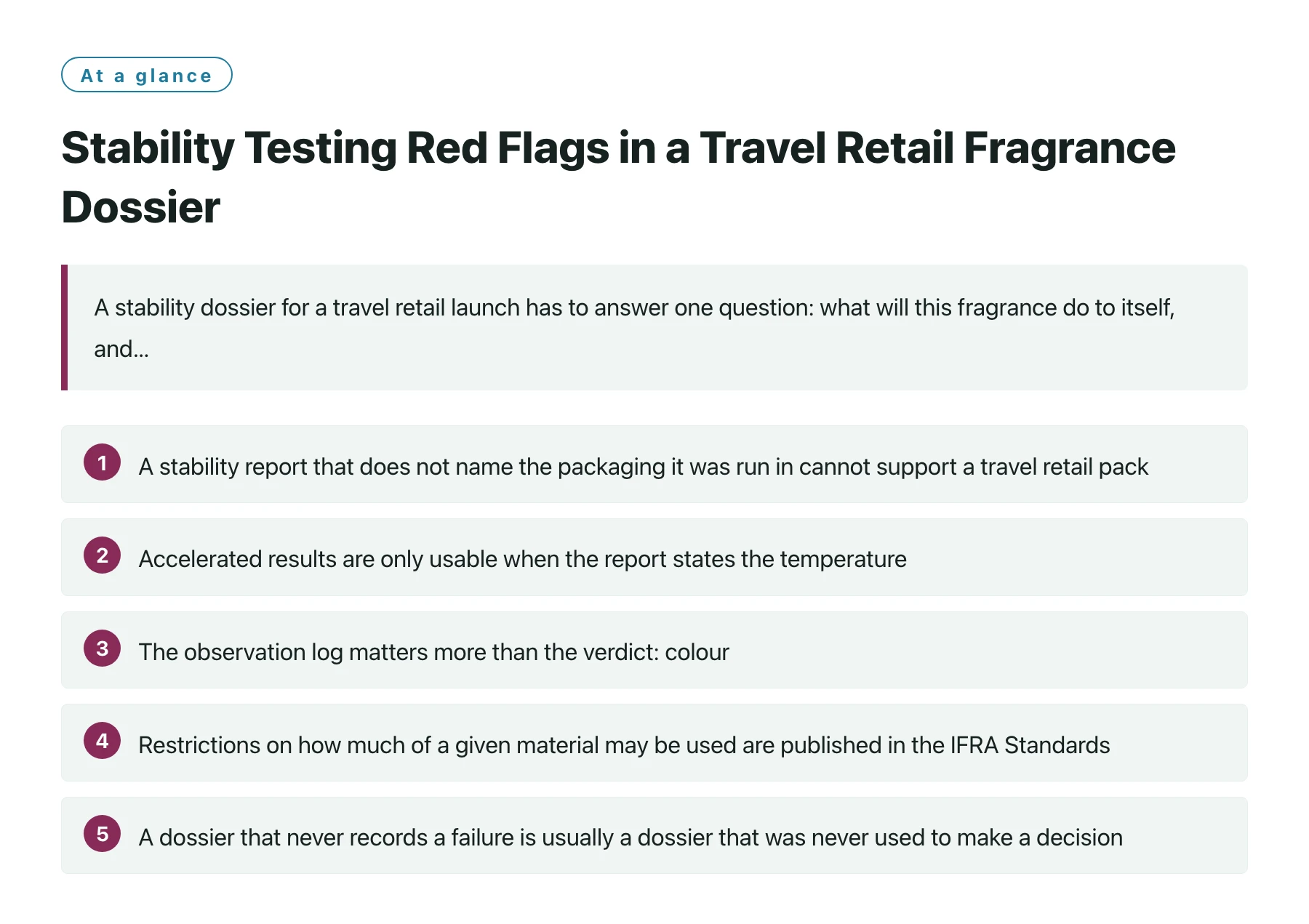
- A stability report that does not name the packaging it was run in cannot support a travel retail pack, because a 10 ml miniature, a tester and a 50 ml retail bottle are three different packages.
- Accelerated results are only usable when the report states the temperature, the humidity, the duration and what was measured at each checkpoint.
- The observation log matters more than the verdict: colour, clarity, odour, weight loss, leakage and sprayer function are where problems appear first.
- Restrictions on how much of a given material may be used are published in the IFRA Standards, so a programme that ignores them is testing a formula that cannot ship as written [1].
- A dossier that never records a failure is usually a dossier that was never used to make a decision, which tells you how seriously the supplier treats the test.
Travel retail compresses a lot of shelf life into a short window of attention. Stock sits in a distributor's warehouse, crosses a border, waits behind a counter and is then bought by someone who will carry it through airports and open it in a different climate. A formula that behaves perfectly in a Guangzhou summer can still lose its top notes, cloud, or seep past a crimp under that sequence.
Buyers reviewing a dossier for the first time tend to look for the section headings: accelerated study, compatibility, conclusion. Reviewers who have been caught out before read the details, because that is where the useful signals sit. The list below is what a review of that kind looks like.
Warning signs, and what each one usually means
| What you see in the dossier | What it often means | What to ask for |
|---|---|---|
| One storage condition, with no ambient control arm | The study was run to produce a pass rather than to find a failure point | The full protocol, including the control sample and every checkpoint |
| The packaging is described only as 'glass bottle' | The test was run on bulk liquid, so the pack was never tested at all | Confirmation that the same vessel, closure and pump were used |
| Results stated only as 'compliant' or 'passed' | Observations were collected and then discarded, taking the comparative data with them | The raw observation log, including colour, clarity and odour notes |
| No statement of the specification version the test ran against | The result cannot be tied to a formula revision, so it will not survive a change | The version-controlled specification and the signature against it |
| The dossier covers concentrate but not filled units | Evaporation, leakage and sprayer function were out of scope | Weight-loss data and a function test on assembled, filled units |
| A shelf life quoted as a single round number | The figure was chosen to match a listing form or a purchase order | The calculation, the conditions behind it and the margin built into it |
None of these signs proves bad faith. Most of them mean the dossier was assembled for a different purpose, and the fix is usually one conversation rather than a new supplier.
Where stability work usually goes wrong
A protocol that is described but not reproducible
A usable protocol names the chamber, the set points, the tolerance around them, the sample size, the fixtures and the checkpoint schedule. Without those, nobody can repeat the run, and a result that cannot be repeated is an anecdote with a letterhead.
It also has to say what the study was trying to prove. The point of accelerated storage is not to declare a product stable; it is to find the conditions under which it stops being stable, and to convert that into a shelf-life estimate with a stated margin. Studies that only look for a pass cannot produce a margin, which is why they end in a single number.
The same standard applies to the age of the sample. A sample that has been sitting on a shelf for two months before the clock starts is not a zero point, and the difference shows up later, when bulk behaves unlike the sample that was signed off why a sample and the bulk order can differ.
The packaging pairing is assumed rather than tested
In travel retail the pack is often the hardest part of the product. A miniature has a high surface-area-to-volume ratio and a thin wall, a tester is opened constantly, and a gift set may combine a fragrance with a body product whose own chemistry has to coexist inside one box. Each of those is a separate compatibility question.
So the first practical check is whether the dossier's packaging matches the packaging you intend to sell. If the report covers a 50 ml crimped bottle and your launch is a 10 ml spray with a screw cap, the study answers a question you did not ask.
The second check is what the study measured. Weight loss over time, seal integrity after handling, pump function at the end of the test, and the condition of any decoration are the fields that predict problems on a counter. A report that covers only the liquid is a partial answer.
The sign-off is missing
A result becomes evidence when it is approved against a specification by a named person whose role you can see. If the dossier has no approval line, or the approver is anonymous, you cannot tell whether a formulator, a quality manager or a sales coordinator decided that the product passed.
There is an external dimension too. Because the safety of a cosmetic product rests on an assessment made before it is placed on the market, packaging compatibility and stability data feed into documents that a brand, not a factory, is accountable for [2]. Knowing who signed is how you know whether the input to that assessment is dependable.
It is also reasonable to ask whether any part of the programme was run independently. Commercial laboratories offer stability and compatibility testing as a service precisely because an in-house pass and a third-party pass are read differently [3]. For a low-risk line, in-house may be sufficient. For a launch that has to convince an airport buyer, the difference is worth pricing.
Finally, place the stability work inside the wider testing picture rather than beside it. A walkthrough of Xuelei shows how material restrictions, microbiological limits for any accompanying body product and packaging checks share the same sample set. A supplier that runs them as one programme tends to produce a dossier that stands up; one that runs them as four separate errands usually produces four documents that do not agree.
Why travel retail raises the bar
Domestic e-commerce tolerates a short shelf life. Stock moves in weeks, returns are manageable and the customer is close by. Travel retail does the opposite. Inventory is committed in advance, it may sit in a duty-free warehouse for a season, and the end customer carries it across borders where the ambient temperature and humidity are outside anything the factory ever saw.
That is why the useful question is not 'how long does it last' but 'how long does it last under the worst realistic sequence we can describe'. A manufacturer used to building fragrance for export channels tends to answer the second version, because it has seen the first one fail. Xuelei Perfumes is the English-facing entry point for a Guangzhou fragrance house that describes 31 years of manufacturing behind it, and it is one place to read how a supplier frames that scope, though the framing is only a starting point for the questions above.
One more practical note. Ask for the dossier in the form you will need it for the market, not the form that is easiest to produce. Different markets ask for different pieces of the same evidence, and rebuilding a document set after a launch date is fixed is far more expensive than specifying it before the first bulk run.
Read the dossier as if you had to reproduce the study yourself. If you cannot describe the chamber, the samples, the checkpoints and the approver after one pass, the report has not told you what it appears to tell you.
Sources
- IFRA: Safe Use and Fragrance Science —— IFRA's explanation of how fragrance materials are scientifically assessed for safe use and how those conclusions are applied by the industry.
- EU Scientific Committee on Consumer Safety (SCCS) —— The EU scientific committee that issues opinions on the safety of cosmetic ingredients, including fragrance allergens and their labelling thresholds.
- SGS: Cosmetics, Personal Care & Household Testing —— Testing, inspection and certification services for cosmetics and personal care, including microbiological, stability and safety testing aligned with cosmetics GMP.
Frequently asked questions
How long should stability testing take before a travel retail launch?
Accelerated work measured in weeks can support a decision, but it should be paired with a real-time arm that keeps running after launch. Treat the accelerated result as a risk screen, not as the final shelf-life claim.
Is a supplier's in-house stability report enough?
It depends on the risk and on the buyer. In-house reports are normal and often adequate, but for a high-visibility listing, a third-party confirmation of the same protocol removes an argument you would otherwise have to win later.
What is the single most common gap in a stability dossier?
The packaging. Reports frequently describe the liquid and omit the vessel, closure and dispensing system, which are the parts that fail first in a travel retail environment.
Should shelf life be quoted on the pack?
Follow the labelling rules of the market you are selling into. Where a period-after-opening symbol or a minimum durability date is required, the number has to come from the study rather than from a round figure chosen for a listing form.
How do we compare two suppliers whose stability data looks similar?
Compare the protocols and the observation logs rather than the conclusions. The supplier that can show you the raw checkpoints, the control arm and the signed specification is usually the one whose bulk order will match the approved sample.
Continue Reading
The Journal publishes ten essays a year, written by our desk and a small roster of outside contributors. Members receive each piece a fortnight before public release.